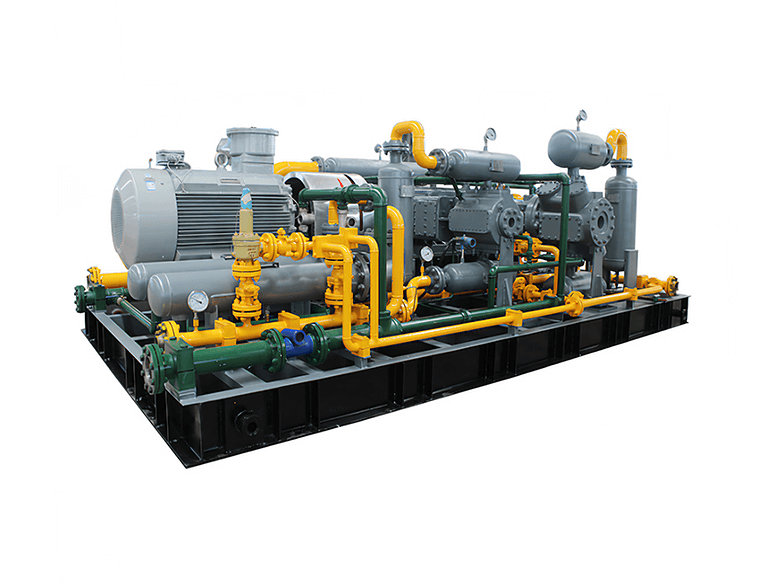
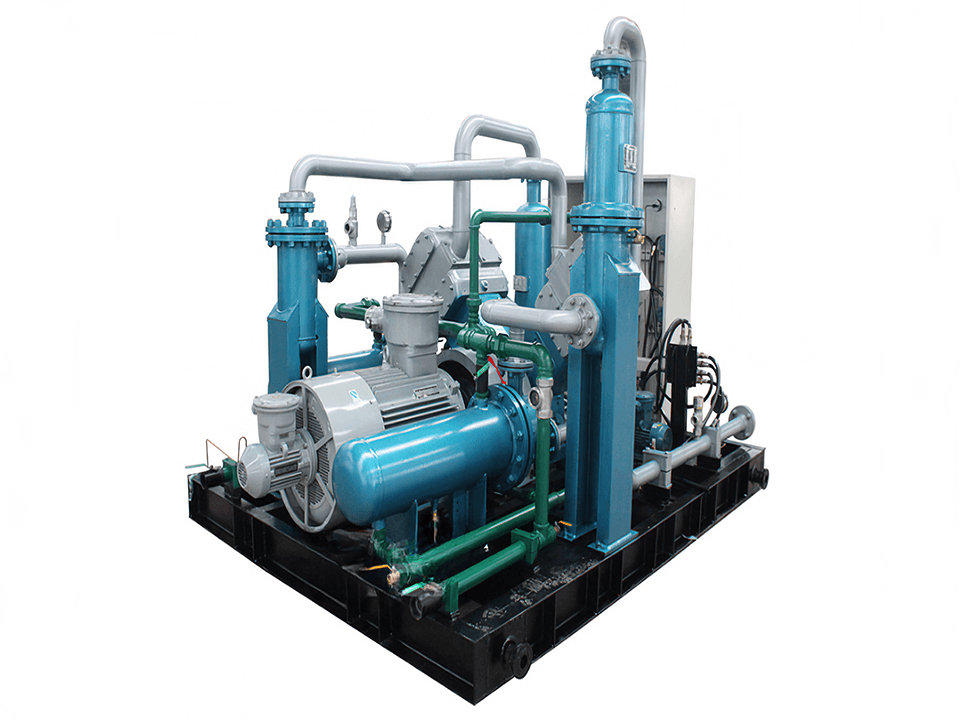
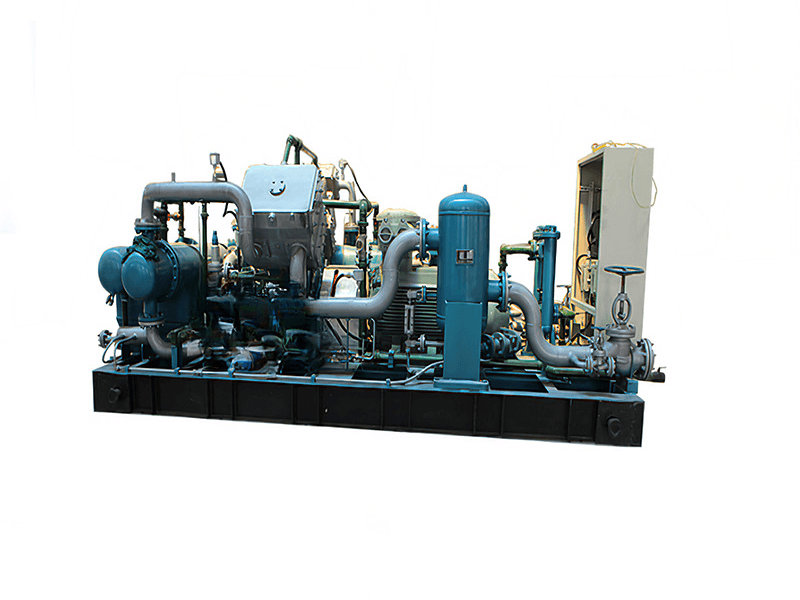
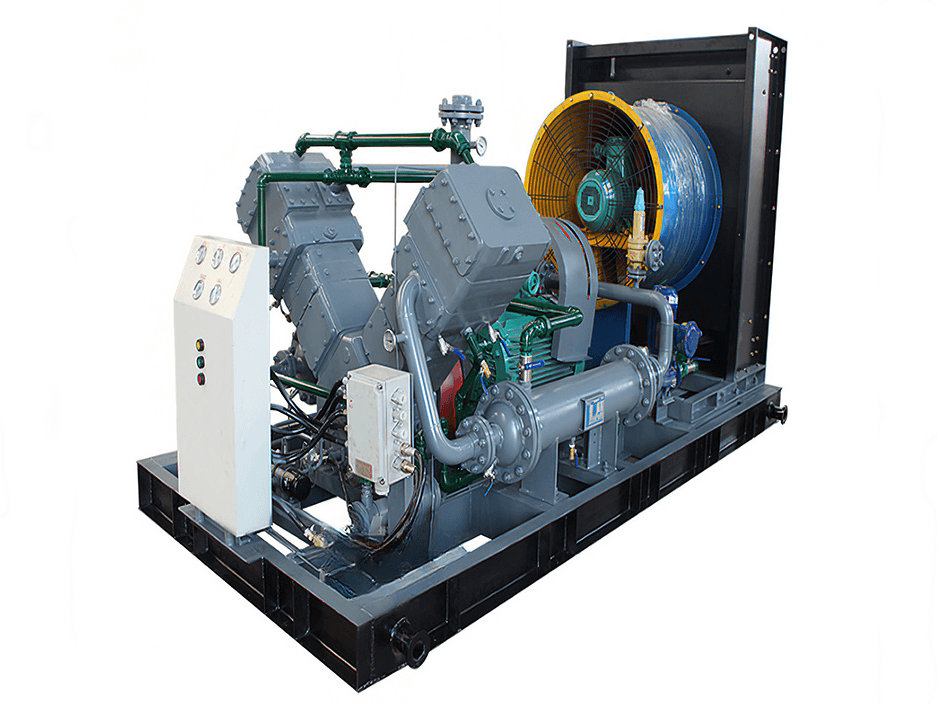
Ammonia refrigeration compressors are primarily categorized into three main types based on their structural configuration and mode of motion: reciprocating (piston), screw, and centrifugal. Additional subtypes such as scroll and diaphragm compressors exist, but their application in ammonia refrigeration engineering remains relatively limited. Equipment selection does not yield a single "best" answer; rather, the most suitable machine for a given project can only be determined by comprehensively weighing factors such as the required refrigerating capacity, operating conditions, energy efficiency targets, and investment and maintenance budgets.
The reciprocating ammonia compressor operates via a crank-connecting rod mechanism that drives the piston in a reciprocating linear motion within the cylinder. It draws in low-pressure ammonia vapor during the suction stroke and discharges it after compression during the compression stroke. This type benefits from mature technology and extensive manufacturing experience, with a substantial installed base in the ammonia refrigeration sector. Its advantages include a wide operating temperature range, stable performance at evaporating temperatures from minus 65°C to plus 5°C, high indicated efficiency, good adaptability to variable operating conditions, broad single-unit capacity coverage, and relatively low initial purchase cost. However, its inherent limitations are equally significant: the overall machine is bulky, it contains numerous wearing parts such as valves, piston rings, and crankshaft bearings, leading to heavy periodic maintenance and replacement workloads and consequently markedly higher long-term maintenance costs. Regarding capacity control, reciprocating compressors predominantly employ cylinder unloading to achieve stepped regulation, which cannot meet the demand for wide-range stepless adjustment. The discharge gas flow exhibits pulsating characteristics, typically necessitating the installation of a surge drum or buffer tank to dampen piping vibration. In summary, this type is suitable for medium-to-high capacity refrigeration systems and applications where stepped capacity control is acceptable.

The screw ammonia compressor, by contrast, employs a pair of intermeshing male and female screw rotors as its core components. As the rotors rotate at high speed within the cylinder, the volume of the rotor grooves changes periodically, thereby accomplishing the suction, compression, and discharge of ammonia vapor. Oil-injected screw compressors are widely used in ammonia refrigeration systems. Their notable advantages include a compact structure with a significantly smaller footprint than reciprocating units of equivalent capacity, and the fact that the only moving parts are the rotors and bearings, resulting in very few wearing parts and markedly improved operational reliability. Owing to the good dynamic balancing characteristics of the rotors, the entire machine exhibits low vibration and smooth, continuous discharge. Moreover, the oil injection cooling effectively suppresses the rise in discharge temperature, making screw compressors insensitive to wet compression and tolerant of liquid carryover without sustaining damage. Capacity regulation is achieved via a slide valve mechanism, enabling continuous stepless adjustment from 10% to 100% of full load. However, this type also has drawbacks: the power consumption per unit of refrigerating capacity is slightly higher than that of high-efficiency reciprocating units, and the oil injection system requires auxiliary components such as oil separators, oil coolers, oil pumps, and filters, complicating the overall system. Additionally, the machining precision required for the rotor profiles is extremely high, necessitating substantial investment in manufacturing equipment. Screw compressors currently dominate large-scale industrial ammonia refrigeration systems and are particularly suitable for continuous-duty process cooling applications.
The centrifugal ammonia compressor operates on a fundamentally different principle from the previous two types. It relies on a high-speed rotating impeller to transfer mechanical energy to the ammonia vapor, imparting substantial kinetic and pressure energy. The gas then decelerates in the diffuser and volute casing, where the kinetic energy is further converted into pressure energy, achieving the required pressure rise. As a dynamic compressor, its single-stage pressure ratio is relatively low, thus typically requiring multiple impeller stages in series to attain the necessary differential pressure. The most distinctive features of centrifugal compressors are their extremely large volumetric flow rates, with single-unit capacities reaching tens of megawatts, and the absence of direct contact friction between the gas and rotating components, resulting in smooth operation, low vibration, and low noise levels. Since there are no wearing parts such as valves or piston rings, maintenance intervals are very long, with major overhauls possible at several-year intervals. However, the initial investment is substantially higher than that of reciprocating and screw types, owing to the need for very high rotational speeds—often achieved through speed-increasing gearboxes or high-speed motors—and the demanding requirements for precision manufacturing and dynamic balancing technology. Furthermore, the performance curve exhibits a surge boundary in the low-flow region, limiting the operational regulation range, and the technical proficiency required of operating and maintenance personnel is higher. Consequently, centrifugal ammonia compressors are primarily employed in ultra-large industrial installations with enormous cooling demands, such as petrochemical complexes, large-scale air separation units, and district cooling stations.
In the compressor selection process, multiple dimensions must be considered, including suitable capacity range, operating efficiency, initial investment, maintenance costs, regulation characteristics, and tolerance to wet operation. Reciprocating compressors offer cost-effectiveness advantages in the small-to-medium and medium-to-large capacity ranges, though their maintenance workload is greater. Screw compressors cover large to extra-large capacity requirements, with moderate initial investment and stepless regulation, and have become the predominant choice in modern industrial refrigeration. Centrifugal compressors are reserved for extra-large to ultra-large projects, offering very high efficiency but with the highest initial outlay and the most pronounced regulation constraints. Actual selection should be based on a comprehensive evaluation of the project-specific cooling load, annual operational energy efficiency ratio, available installation space, cooling water source conditions, and payback period. It is advisable, after preliminary screening, to commission professional design institutes or compressor manufacturers to conduct detailed operating condition calculations and techno-economic analyses, thereby ensuring that the selected compressor type delivers optimal overall life-cycle benefits for the project.